
Packing is where most panel complaints start
Perforated aluminium and coated steel acoustic panels are not fragile, but they are easy to mark. A scratch on a powder-coated face, a dented edge on a 2×1 metre panel, a bent H-post flange — none of these affect acoustic performance, and all of them trigger a claim on site. Over the years, our packing method has been adjusted mostly by listening to those claims. This is what it looks like today.
Step 1 — Surface protection on every visible face
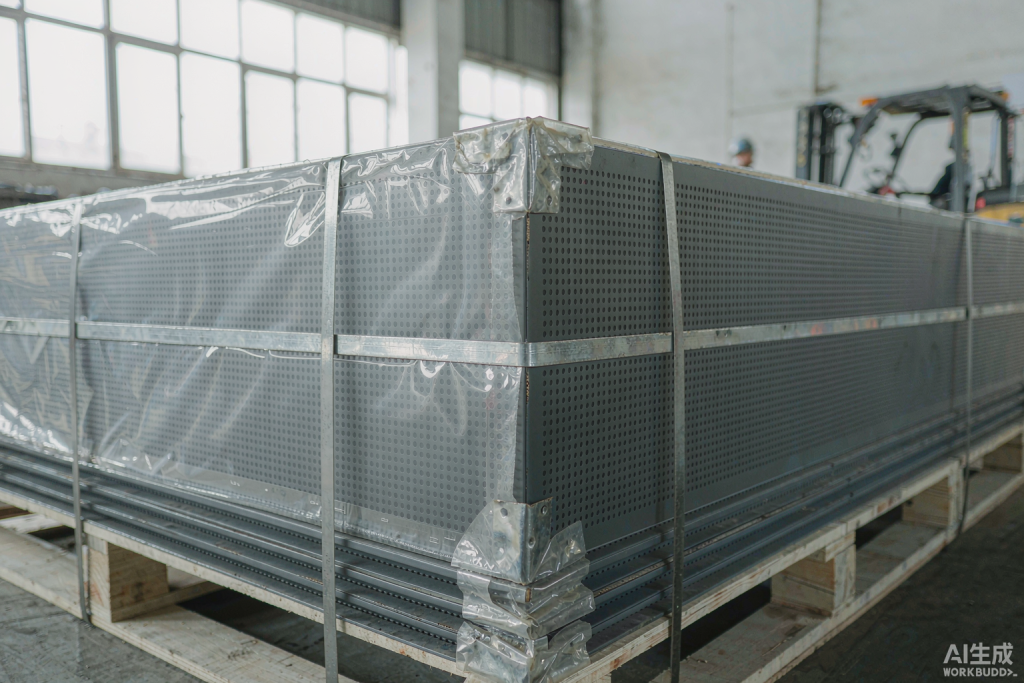
Panels are covered with a PE protective film on the side that will remain exposed after installation. The film stays on until the panel is fixed in place, so drilling, cutting and handling marks never reach the coating. For projects with a colour match requirement, panels from the same coating batch are packed together and marked accordingly.
Step 2 — Separators, corner protection and strapping
Panels are stacked face to back, never face to face. Between panels we insert separators, and every stack corner receives plastic or cardboard corner protectors before strapping. Steel strapping is applied to timber pallets at calculated intervals so the load stays rigid during lifting and ocean transit — a stack that shifts in a container will always come out damaged.
Step 3 — Fumigation-free crating for accessories
H-posts, flanges, bolts, brackets and touch-up paint travel separately in plywood crates. Plywood is used deliberately: it is exempt from ISPM 15 solid-wood treatment requirements, which avoids customs delays at destination. Each crate is labelled with a part mark that matches the installation drawing.
Step 4 — Loading and securing
Standard panels are loaded into 20GP, 40GP or 40HQ containers depending on panel length and order volume; over-length components go into 40OT or flat racks. Before the doors are closed we photograph the secured load and send the images with the shipping documents — you see exactly how your order left the factory.
Weight distribution matters as much as bracing. Heavy posts are placed over the container axles, and panels are blocked against the container walls so that no movement is possible even in heavy weather.
Step 5 — Documents that match the material
A packing list is only useful if it matches what the installer sees on site. Our packing list uses the same part marks as the installation drawing (elevation A, B, C), so your site team can unpack per elevation instead of sorting 400 identical-looking panels. The full document set includes:
- Packing list with part marks and weights per crate
- Bill of lading and certificate of origin
- CE declaration of performance for EN 10223-4 fencing products
- Third-party test reports on request (tensile strength, coating thickness, RoHS)
- Installation drawings and touch-up procedure
Shipping terms we work with
We quote EXW, FOB Qingdao or Tianjin, CIF and DDP depending on what your project requires. Samples and small retrofit orders ship LCL; full projects ship FCL with the loading plan agreed before production starts.
Two tips for receiving the container
- Store panels flat on dunnage. Never lean a stack against a wall for more than a few days — coated panels take a permanent set.
- Keep the touch-up kit with the site supervisor. Small transit marks are normal on any coated product; a two-minute touch-up avoids a two-week argument.
If you would like to see the packing method for a specific product — highway noise barrier, railway sound wall, bridge anti-throw fence or perimeter fencing — ask our export team for the packing specification sheet before you place the order.